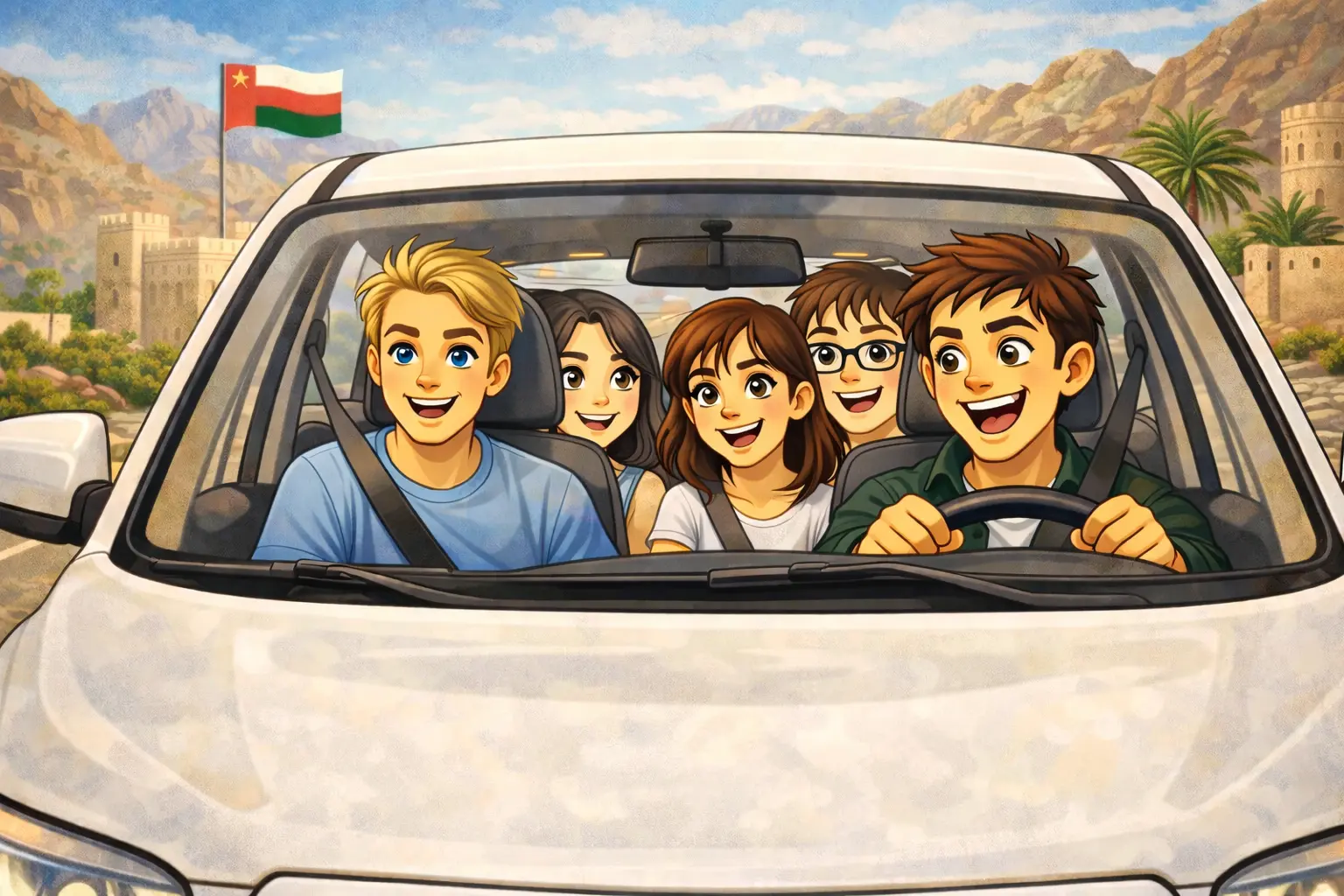
Checking our expenses after a three-week long road trip made meI realize that the best things in life are often not the ones that we pay the most for.
“That can’t be right, there must be a miscalculation here. I’d budgeted two or three times this amount.”
When we returned from our holiday in Oman, we did what any group of friends does after three weeks on the road together: splitting the bill.
Transport, accommodation, food, activities, literally everything except the flight that we’d already paid for. We’d driven over five thousand kilometers in a brand new four-wheel drive, slept in lodges and desert camps, had eaten until we couldn’t move, hiked mountains, swam in hidden pools, and watched the sun set over dunes that looked like they’d been painted. Three weeks of the kind of travel you’d assume costs a small fortune.
The total had come in at just over €1,100 per person.
We checked the math twice, and actually checked our banking apps to evaluate whether there were expenses that were missing. For some inexplicable reason, twenty-one days of adventure across one of the most beautiful and friendly countries I’ve ever been to had cost less than a new iPhone.
We hadn’t set out to do a budget trip in the slightest. We weren’t camping to save money or skipping meals, had comfortable stays, ate so much we all gained a couple of pounds, and in general just did everything we wanted.
The trip had simply been amazing, but when I was finally back on Dutch soil, still amazed by the total costs, it hit me: more or less everything that we’d done, and certainly the moments that we would remember the most, had barely cost anything at all.
Why Oman
Oman might actually be one of the most underrated holiday destinations, and this three-week road trip hadn’t been my first time there. I’d already visited twice during my student years, mixing study with exploration. Still, coming back with four close friends almost five years later was different. It wasn’t just about making memories, it was about sharing them.
Others have frequently asked why I preferred to visit Oman when more popular places like Dubai or Abu Dhabi are literally on the other side of the Hajar mountain range. And although I’ve visited the Emirates as well and had a wonderful time there, the answer is simple: the UAE has made a conscious choice to trade a large part of its cultural authenticity for elements of luxury and prestige from all over the world, creating a (in my view) somewhat superficial culture of status and extravagance. I have, for example always been baffled that the Emirate of Abu Dhabi has paid approximately $525 million to use the name “Louvre” for one of its museums. Completely nuts.
Oman has deliberately decided to exist on the exact opposite of that spectrum, and its entire tourism strategy is built around what it’s always had: hospitality that feels genuine, culture that runs deep, and a kind of unpolished authenticity that’s increasingly rare to find these days.
The result of that strategy could actually be directly felt in our pockets. By emphasizing and experiencing what the country already naturally possessed and offered, there was no need to pay extra for luxury and extravagance. The beauty was already there, and it wasn’t asking for a premium at all.
Abundance Without Invoices
After landing at Muscat airport, we picked up a brand new 4×4 with less than 500 kilometers on the clock at a local rental company. The total costs? Easily less than half of what the airport kiosks would’ve wanted for the exact same vehicle.
We took the rest of that day to recover from the flights, and explored the Corniche and Mattrah Souq in the evening. The next day we went looking for somewhere to swim. Some questionable Google Maps scrolling led us first to the building site of a new Trump resort instead of the beautiful bay we were promised, but fortunately our second try landed us on a hidden beach with turquoise water and not another person in sight.
No entrance fee and no crowds, but just us, the sea, and the good life.
That experience set the tone for everything that followed, and probably shaped many of the choices for the visits we made after. After leaving Muscat we drove north, and the highlights kept arriving without any invoices attached.
We hiked in the Hajar mountains, where cliffs older than recorded history made us feel like specks in a painting. We visited the beehive tombs of Bat, burial sites older than the pyramids, standing almost alone in the desert because hardly anyone knows they exist. We walked the balcony trail at Jebel Shams, Oman’s answer to the Grand Canyon on a trail that’s equally breathtaking as it is terrifying. We watched the goat market in Nizwa, which operates with all the intensity of a stock exchange except the assets bleat. And from there we drove to Wahiba Sands, Oman’s desert, where we watched the sun set under the dunes and had one of the most amazing views of the Milky Way I’ve ever had.
None of those experiences, bar the overnight stays in between, had cost us a single euro. The mountains didn’t charge admission, the ancient tombs had done fine without a ticket booth for five thousand years already, and the stars and campfire laughter in the desert came free of charge as well.
The Long Road South
After our desert visit we drove to Salalah, literally on the other side of the country. It meant driving nearly a thousand kilometers south through a landscape so monotonous that Google Maps literally told us to continue driving straight for 730 (!) kilometers until the next roundabout. Normally we’re a bunch of talkers, but even the classic road trip discussion about whether men and women can be friends will at some point die a silent death if the surroundings don’t bring any stimulation whatsoever. You’ll probably not be surprised that we now refer to the trip itself as “the most forgettable drive of our lives”.
Fortunately, Salalah itself was worth every empty kilometer. Green mountains that looked borrowed from another continent, and a more upbeat atmosphere that we hadn’t experienced in the rest of the country. We visited the ruins of ancient trading ports, accidentally joined a local festival organized at a museum, and did a snorkeling trip where we literally floated above a shipwreck that was hidden just offshore.
On our way back north, instead of driving 730 kilometers back again until the next roundabout, we decided to take the coastal road . It was, easily one of the best driving experiences I’ve ever had, even better than driving through the desert earlier that trip. The landscapes shifted like someone was changing television channels in front of our eyes: beaches, cliffs, valleys, mountains, literally a whole Planet Earth series passing by in a couple of hours. The only cost we had to make for it was the petrol, and we would’ve needed that regardless of which route we took.
On our trip back toward Muscat, we stopped at the Oman Across Ages Museum, cooled off in the Wadi Bani Khalid and Wadi Shab, and on a whim during our stay in Sur caught a screening of the newly released Wicked movie dubbed in Arabic. When we arrived back in Muscat and handed in the car with over six thousand kilometers on the counter, our last night was a splurge: a luxury hotel in Muscat that felt like a palace, even though we’d already had very comfortable stays in the meantime. And from there, after a good night of sleep, it was back on the plane, heads full and wallets less dented than anticipated.
Remembering What I Paid Nothing For
Looking back, the reason for the surprise we experienced when taking a good look at the total expenses was evidently hidden in plain sight: almost none of the things that had made this trip unforgettable actually involved spending significant money.
The balcony walk didn’t cost us anything, and neither did the wadi swims or the hidden beaches. The desert silence was free, and so were the stars, the laughter around the campfire, the stories we’ll retell for years, none of it came with a receipt.
And in the instances that we did have to spend, all of it was manageable. Food was cheap if you just followed your nose and the locals, museum visits did not require us to pay the jackpot, and we could share the costs on transport and accommodation. We also unintentionally chose comfort over luxury from the start, and because the country always met us halfway at every turn we never felt like we were missing out or had to upgrade our standards or needs.
Today, I still occasionally think about the Oman trip. It’s a gentle reminder that the best parts of life are often cheap or free, and that they always will be because they require a completely different effort to obtain. They just require you to show up, go out, pay attention, and actively share your own joy with the people who matter.
About The Fillennial
The Fillennial is a Dutch blogger on a mission to inspire better and healthier money conversations, by bringing back the true ‘personal’ in personal finance. On his blog he openly shares the core memories that have shaped his relationship with money, and the unexpected lessons that emerged from them.
And if you read carefully, there might be more hiding in his stories than you’d expect…
Learn more →